Wealth management has always been relationship-driven.
But behind every client relationship is an enormous amount of operational work.
Client meetings need to be documented. CRM records need to be updated. Follow-ups need to be tracked. Compliance documentation needs to be prepared. Portfolio discussions need to be summarized accurately. Internal coordination needs to happen across advisors, assistants, operations teams, and compliance stakeholders.
Most advisory firms are not struggling because they lack expertise.
They are struggling because execution has become fragmented.
And this is exactly where AI in wealth management is starting to create real operational value.
The conversation around artificial intelligence in financial services often focuses on predictions, robo-advisors, or automated investing. However, the real transformation is happening elsewhere.
AI is increasingly becoming the operational layer that helps wealth advisors manage conversations, workflows, compliance, and client intelligence more efficiently.
The shift is no longer about replacing advisors.
It is about reducing operational friction so advisors can focus more on relationships, trust, and strategic decision-making.
The Hidden Operational Burden Inside Wealth Management Firms
Most wealth advisory firms run on conversations.
Client meetings drive decisions. Reviews uncover opportunities. Portfolio discussions reveal concerns. Market updates trigger action items.
But once the meeting ends, the real operational burden begins.
Advisors often spend hours every week manually updating CRMs, writing summaries, preparing follow-up emails, documenting compliance notes, organizing client information, and coordinating across internal systems.
In many firms, this process still depends heavily on memory and manual effort.
A typical workflow often looks like this:
- Conduct client meeting
- Take scattered notes
- Update CRM later
- Draft follow-up manually
- Prepare compliance documentation separately
- Search across emails and files for context before the next meeting
Over time, this creates operational inefficiencies that scale with the business.
As advisory firms grow, the volume of conversations increases. More clients mean more meetings, more documentation, more coordination, and more compliance requirements.
Without structured operational systems, advisors become buried under administrative overhead.
This affects:
- Client responsiveness
- Data consistency
- Compliance readiness
- Advisor productivity
- Internal coordination
- Revenue opportunities
The challenge is not the lack of information.
The challenge is turning conversations into structured execution.
Why Traditional Wealth Management Technology Still Creates Friction
Most wealth management firms already use technology.
They have CRMs, portfolio management systems, communication platforms, document repositories, and meeting tools.
Yet operational friction still exists.
Why?
Because most tools were built to store information, not orchestrate workflows.
Traditional CRMs require manual updates.
Meeting platforms stop at recordings or transcripts.
Compliance systems operate separately from client conversations.
Knowledge remains fragmented across multiple tools.
As a result, advisors still spend significant time:
- Rewriting meeting notes
- Searching for client context
- Updating records manually
- Coordinating follow-ups
- Preparing audit-ready documentation
Even modern AI note-taking tools often solve only a small part of the workflow.
Generating a transcript is not the same as operational execution.
Real operational intelligence requires systems that can understand conversations, structure insights, trigger workflows, and coordinate actions across the advisory lifecycle.
This is where the next evolution of AI in wealth management is emerging.
How AI Is Actually Being Used in Wealth Management
The practical use of AI in wealth management is moving far beyond chatbots and generic automation.
Advisory firms are increasingly using AI to streamline operational workflows and reduce administrative complexity.
Meeting Intelligence
Client meetings contain valuable information:
- Financial goals
- Risk concerns
- Investment preferences
- Family planning discussions
- Compliance disclosures
- Follow-up actions
AI systems can now capture and structure these conversations automatically.
Instead of relying on manual notes, advisors can generate:
- Structured summaries
- Action items
- Client insights
- Follow-up drafts
- Meeting highlights
- Decision logs
This improves accuracy while reducing post-meeting workload.
CRM Automation
One of the largest operational pain points in advisory firms is CRM maintenance.
Advisors often delay updates because documentation consumes time.
AI can help automate:
- Client interaction summaries
- Relationship updates
- Opportunity tracking
- Follow-up reminders
- Activity logging
This helps maintain cleaner and more actionable client records.
Compliance Documentation
Compliance remains one of the most documentation-heavy areas of wealth management.
Advisors need detailed records of:
- Recommendations
- Client communications
- Disclosures
- Risk acknowledgments
- Suitability discussions
AI systems can help generate structured compliance-ready documentation based on actual conversations and advisor-reviewed outputs.
This reduces manual overhead while improving audit readiness.
Pre-Meeting Intelligence
Preparing for client meetings often requires reviewing:
- Previous meeting notes
- Portfolio updates
- CRM records
- Pending tasks
- Market developments
- Client history
AI systems can consolidate this information into structured pre-meeting briefings.
This allows advisors to enter meetings with better context and preparation.
Workflow Automation
Many advisory workflows still require repetitive manual coordination.
Examples include:
- Assigning follow-up tasks
- Scheduling reviews
- Sending recap emails
- Updating internal systems
- Managing approvals
- Tracking open client actions
AI-powered workflow systems can automate much of this operational coordination.
The result is faster execution with less operational drag.
The Rise of AI Agents in Wealth Management
The next phase of AI in wealth management is not just AI assistants.
It is AI agents.
Traditional AI tools mainly respond to prompts.
AI agents operate more like execution systems.
Instead of simply generating outputs, they can:
- Understand operational context
- Coordinate workflows
- Trigger actions
- Structure information
- Maintain continuity across tasks
- Connect systems together
This shift is particularly important for wealth management because advisory operations are deeply workflow-driven.
A single client interaction may involve:
- Meeting intelligence
- CRM updates
- Compliance documentation
- Portfolio coordination
- Internal approvals
- Follow-up execution
Managing this manually creates bottlenecks.
AI agents help reduce this fragmentation.
For example, a modern advisory workflow may include:
Meeting Intelligence Agent
Captures conversations and converts them into structured outputs such as summaries, action items, decisions, and CRM-ready updates.
Meeting Prep Agent
Prepares advisors before meetings using previous conversations, client records, portfolio context, and pending actions.
Compliance Documentation Agent
Supports advisor-reviewed documentation, audit trails, and structured compliance workflows.
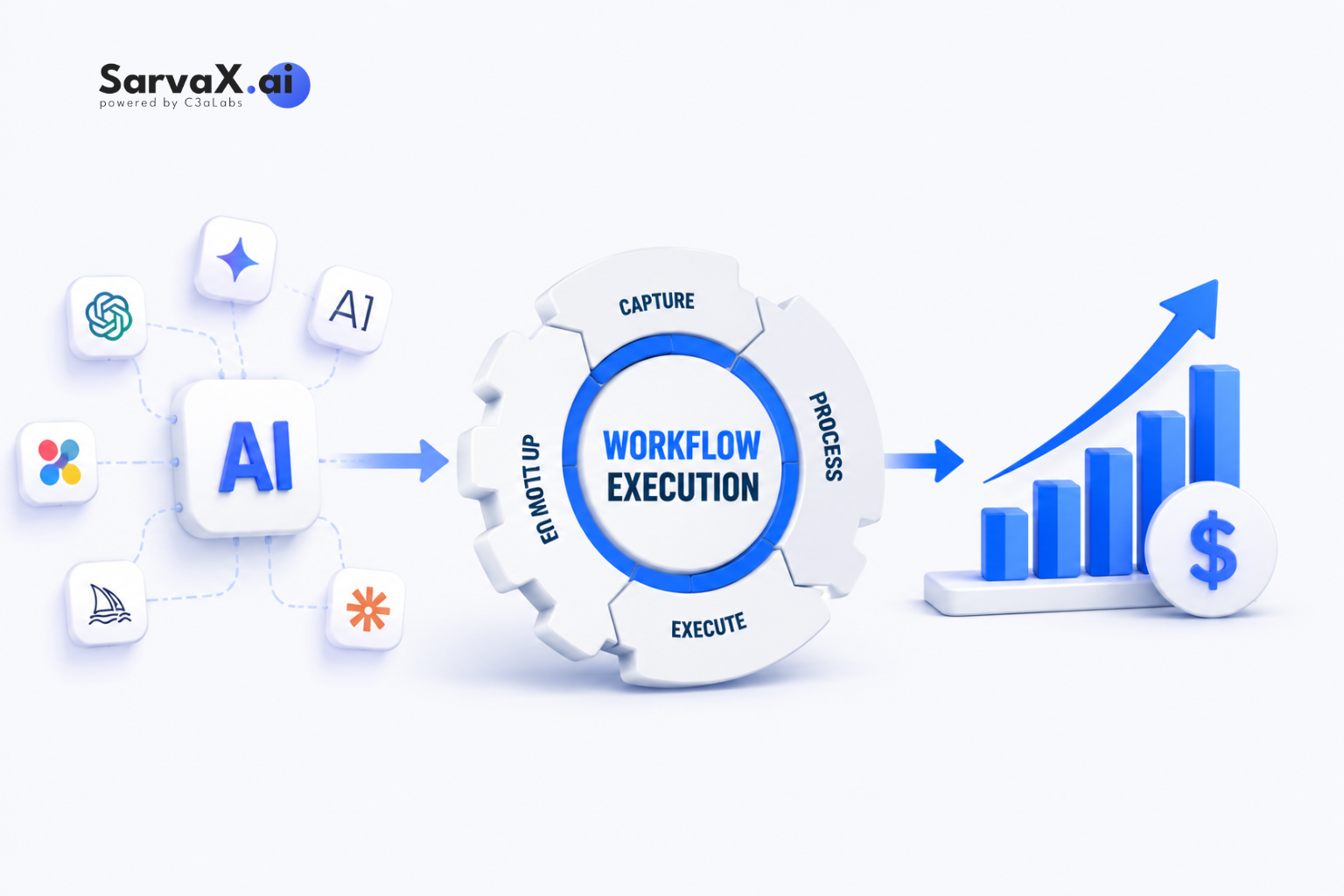
Together, these systems create a connected operational layer around advisory work.
How SarvaX.ai Helps Wealth Advisory Firms Reduce Operational Overhead
SarvaX.ai is designed to help organizations transform fragmented workflows into connected execution systems powered by AI agents.
For wealth advisory firms, this means reducing the operational burden surrounding client conversations and internal coordination.
Instead of treating meetings, CRM systems, compliance workflows, and follow-ups as disconnected processes, SarvaX.ai helps connect them into one operational layer.
The platform supports workflows such as:
- Real-time meeting intelligence
- Structured meeting summaries
- CRM-ready outputs
- Advisor-approved compliance documentation
- Follow-up coordination
- AI-powered workflow execution
- Enterprise search across conversations and documents
- Cross-system operational intelligence
The focus is not simply on transcription.
The goal is operational execution.
This helps advisory firms reduce time spent on repetitive administrative work while improving consistency and visibility across client operations.
Why Security and Governance Matter in Financial AI
AI adoption in financial services requires more than automation.
It requires trust.
Wealth management firms handle highly sensitive client information, including:
- Financial records
- Portfolio details
- Family planning discussions
- Tax considerations
- Regulatory documentation
As a result, security and governance are critical.
Firms evaluating AI systems increasingly look for:
- Secure infrastructure
- Controlled data access
- Audit-ready workflows
- Human approval layers
- Data privacy protections
- Enterprise governance controls
- Model flexibility
This is especially important as firms move beyond isolated AI experiments and begin integrating AI into operational workflows.
AI systems must support both productivity and governance simultaneously.
The Future of Wealth Management Is AI-Augmented Execution
The future of wealth management will not be defined by replacing advisors with AI.
It will be defined by reducing operational friction around advisors.
The firms that scale effectively over the next decade will likely be those that:
- Capture operational intelligence more effectively
- Reduce administrative overhead
- Improve execution consistency
- Maintain stronger compliance workflows
- Create more connected advisor experiences
AI is becoming the infrastructure layer that enables this shift.
Not by replacing relationships.
But by helping advisors spend less time managing fragmented workflows and more time serving clients strategically.
This is where AI in wealth management is creating its most meaningful impact.
FAQs
How is AI used in wealth management?
AI in wealth management is used for meeting intelligence, CRM automation, compliance documentation, workflow automation, portfolio insights, and operational coordination.
Can AI automate CRM updates for financial advisors?
Yes. Modern AI systems can generate CRM-ready summaries, track follow-ups, and structure client interaction data automatically.
What are AI agents in wealth management?
AI agents are systems designed to execute operational workflows, coordinate tasks, and structure information across advisory processes instead of simply responding to prompts.
Can AI help with compliance documentation?
Yes. AI can assist advisors by generating structured compliance-ready documentation based on meeting conversations and operational workflows.
Is AI secure for financial advisory firms?
Enterprise AI platforms increasingly include governance controls, secure deployment models, audit trails, approval workflows, and data privacy protections designed for regulated industries.
Will AI replace wealth advisors?
No. AI is more likely to augment advisory operations by reducing repetitive administrative work and improving workflow execution, allowing advisors to focus more on client relationships and strategic guidance.
Final Thoughts
AI in wealth management is no longer just about automation.
It is becoming an operational execution layer for advisory firms.
As client expectations grow and operational complexity increases, firms need systems that can transform conversations into structured workflows, actionable intelligence, and coordinated execution.
Platforms like SarvaX.ai are helping advisory firms move beyond fragmented tools and toward AI-powered operational infrastructure built for modern wealth management.