Most wealth advisors are not losing time because they lack expertise.
They’re losing time because too much of their day is spent on operational work that happens around client relationships.
Meeting notes. CRM updates. Follow-ups. Compliance documentation. Client prep. Internal coordination.
None of these tasks directly generate revenue. But they consume hours every single week.
And this creates a dangerous cycle.
The more time advisors spend on admin work, the less time they spend where real value is created:
- client conversations
- relationship building
- strategic advice
- revenue-generating activity
This is exactly why AI is becoming one of the biggest operational shifts in wealth management.
Not because it replaces advisors.
But because it removes the invisible workload slowing them down.
Where Wealth Advisors Actually Spend Their Time
Most firms underestimate how much operational drag exists inside daily workflows.
A typical advisor’s week includes:
- Preparing for meetings
- Reviewing client history
- Writing meeting summaries
- Updating CRM systems
- Drafting follow-up emails
- Managing tasks and reminders
- Organizing compliance records
Individually, these tasks feel small.
But combined, they consume enormous amounts of time.
In many firms, advisors spend:
- 1–2 hours daily on administrative work
- 5–10 hours weekly on post-meeting workflows alone
- Additional hours preparing for upcoming client meetings
Over time, this becomes unsustainable.
Because growth creates more clients, but also more operational overhead.
The Real Cost of Manual Work
The problem isn’t just time.
It’s what that lost time prevents advisors from doing.
When operational work increases:
- client responsiveness slows down
- follow-ups become inconsistent
- preparation quality drops
- opportunities get missed
And eventually, the client experience suffers.
This is where AI creates real value.
Not by making advisors work harder.
But by removing the repetitive work that drains momentum from the business.
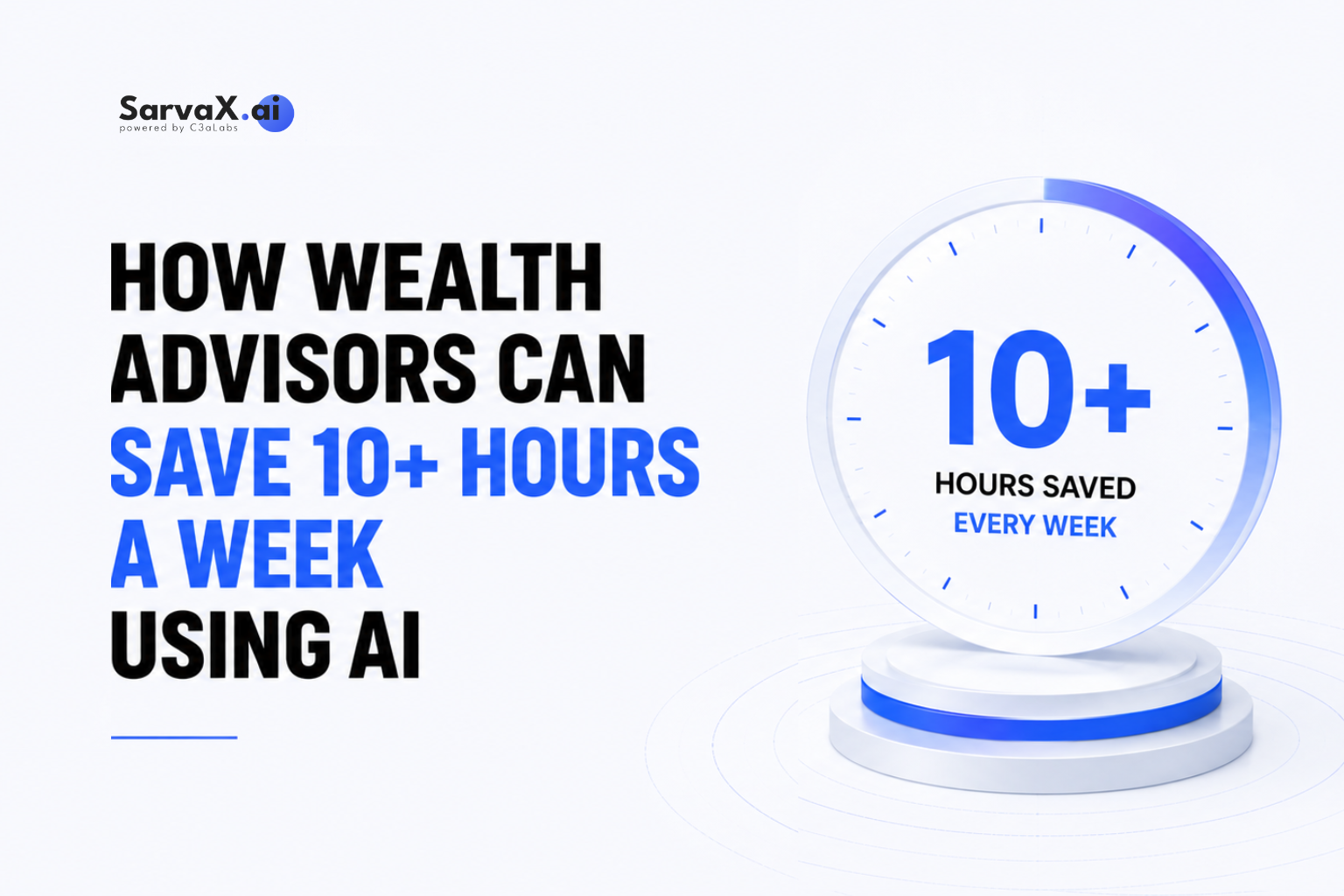
How AI Saves Wealth Advisors 10+ Hours Per Week
The biggest gains happen when AI is connected across the full advisory workflow.
Let’s break it down.
1. Automatic Meeting Summaries and Notes
One of the biggest time drains in wealth management happens after client meetings.
Most advisors still spend time:
- writing summaries manually
- organizing notes
- documenting decisions
- tracking next steps
This process is repetitive and inconsistent.
AI changes this completely.
Instead of manually documenting every conversation, the system automatically generates:
- structured meeting summaries
- action items
- client decision logs
- follow-up recommendations
What used to take 20–30 minutes per meeting now happens instantly.
For advisors running multiple meetings daily, this alone can save several hours every week.
2. CRM Updates Without Manual Data Entry
CRM systems are critical for advisory firms.
But manual CRM updates are one of the most frustrating parts of the job.
Advisors often delay updates because:
- they’re repetitive
- time-consuming
- difficult to maintain consistently
As a result, CRM data becomes incomplete or outdated.
AI solves this by converting conversations directly into structured CRM updates.
Instead of manually entering:
- meeting details
- client concerns
- next steps
- portfolio discussions
The system updates records automatically.
This reduces administrative workload significantly while improving data accuracy across the firm.
3. Faster Follow-Ups and Client Communication
Follow-ups are essential in wealth management.
But drafting personalized communication after every meeting takes time.
AI can automatically generate:
- follow-up emails
- review summaries
- client recaps
- task reminders
The advisor simply reviews and approves.
This dramatically reduces communication time while improving responsiveness.
And in relationship-driven businesses, responsiveness directly impacts trust and retention.
4. Smarter Client Meeting Preparation
Preparation is another major hidden workload.
Before every client meeting, advisors often need to:
- review CRM history
- check portfolio performance
- revisit previous conversations
- gather documents and notes
This process can easily consume 30–60 minutes per meeting.
AI-powered meeting preparation systems reduce this to minutes by automatically generating briefing packs that include:
- client history
- previous meeting context
- portfolio insights
- risk indicators
- suggested talking points
Instead of searching across disconnected systems, advisors enter meetings fully prepared instantly.
5. Reduced Compliance Documentation Work
Compliance documentation is necessary, but extremely time-consuming.
Manual processes create:
- duplicated work
- inconsistent records
- audit stress
AI helps automate compliance workflows by:
- generating audit-ready summaries
- maintaining structured interaction logs
- tracking disclosures and decisions
This reduces back-office workload while improving operational consistency.
More importantly, it reduces the risk of missing critical documentation.
The Compounding Effect of Time Savings
Saving 10 hours per week is not just about efficiency.
It changes how advisory firms operate.
Let’s look at the bigger picture.
More Time for Revenue-Generating Work
When advisors spend less time on admin:
- they can handle more client relationships
- improve responsiveness
- increase meeting quality
- focus on growth initiatives
This creates direct business impact.
Better Client Experience
Clients notice:
- faster communication
- stronger follow-ups
- better preparedness
This improves trust, retention, and long-term relationship value.
Reduced Team Burnout
Operational overload is one of the biggest causes of advisor fatigue.
AI reduces repetitive work and allows teams to focus on higher-value tasks instead of constant administrative execution.
Improved Operational Scalability
Without automation, growth creates operational chaos.
With AI-driven workflows:
- processes become standardized
- execution becomes consistent
- firms scale without dramatically increasing overhead
Why Most Firms Still Struggle to Save Time
Many firms adopt AI tools but see limited impact.
Why?
Because they automate isolated tasks instead of fixing workflow structure.
For example:
- using AI only for transcription
- disconnected CRM systems
- no workflow automation
- manual approvals everywhere
The result is fragmented efficiency.
Not transformation.
The Future of Wealth Management Operations
The next generation of advisory firms will not operate through disconnected systems and manual coordination.
They will operate through:
- connected workflows
- structured client intelligence
- automated execution systems
Where:
- meetings trigger actions
- actions update systems
- systems maintain records automatically
This is where the biggest productivity gains will come from over the next few years.
Final Thought
The goal of AI in wealth management is not to replace advisors.
It’s to remove the operational friction slowing them down.
Because advisors create value through:
- relationships
- trust
- strategic thinking
Not repetitive admin work.
The firms that win will be the ones that free advisors to focus on what actually matters while the system handles the operational layer in the background.
And when that happens, saving 10+ hours per week becomes just the beginning.
If your advisory team is spending hours every week on notes, CRM updates, follow-ups, and compliance documentation, the problem is not your people.
It’s the workflow.
SarvaX.ai helps wealth advisory firms automate post-meeting execution, CRM updates, follow-ups, and compliance workflows so advisors can focus on clients instead of admin work.
Explore how SarvaX.ai can help your firm save time, improve execution, and scale efficiently.