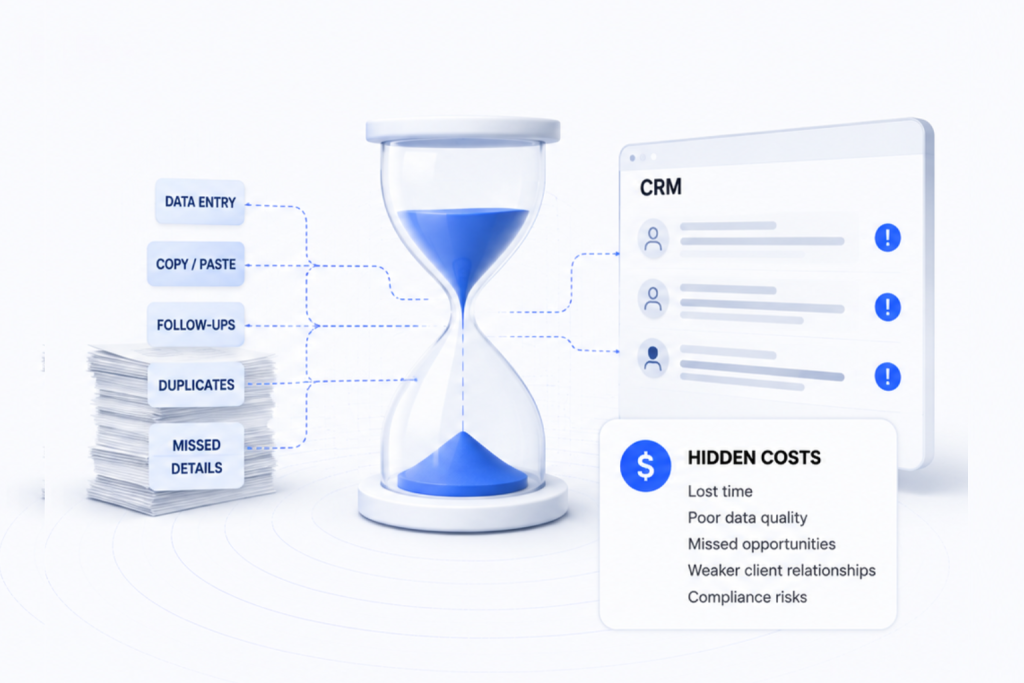
Most wealth advisory firms already have a CRM.
But having a CRM and having reliable client intelligence are two completely different things.
Because here’s the uncomfortable reality:
In many firms, the CRM only reflects what advisors remembered to update.
Not what actually happened.
That creates a massive operational blind spot.
Client conversations happen daily. Important signals are discussed. Decisions are made. Opportunities emerge.
But when CRM updates are manual, much of that information never makes it into the system accurately.
And over time, this creates something far more dangerous than inefficiency:
- inconsistent client data
- poor decision-making
- missed revenue opportunities
- increased compliance risk
The problem isn’t the CRM itself.
The problem is the workflow around it.
Why Manual CRM Updates Break Wealth Management Operations
Wealth management is deeply relationship-driven.
Every interaction matters:
- client concerns
- portfolio discussions
- risk tolerance changes
- life events
- follow-up commitments
But most firms still rely on advisors to manually document all of this after meetings.
That sounds manageable in theory.
In reality, it rarely works consistently.
What Actually Happens After Most Client Meetings
A typical advisor finishes a meeting and immediately moves to the next task.
The CRM update becomes something they plan to complete “later.”
When that happens:
- details get forgotten
- notes become simplified
- context disappears
- updates are delayed or skipped entirely
Over time, CRM records become fragmented.
Some clients have detailed histories. Others have partial updates. Some interactions never get logged at all.
The result is a system full of incomplete truth.
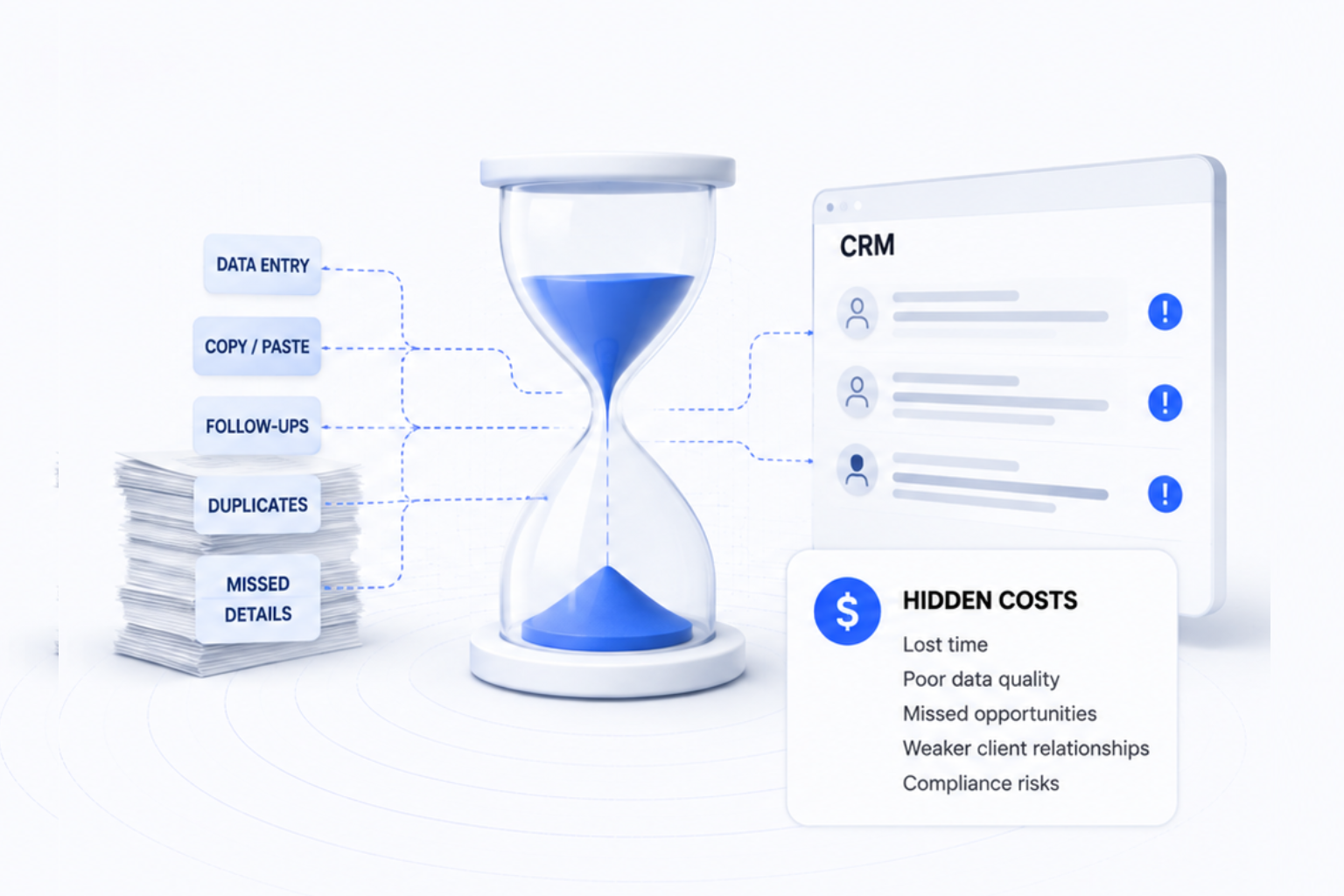
The Hidden Cost Most Firms Don’t Measure
The damage from manual CRM updates is not always obvious immediately.
That’s why many firms ignore it.
But the long-term impact is significant.
1. Inconsistent Data Leads to Poor Decisions
Advisors and leadership teams rely on CRM systems to understand:
- client relationships
- opportunities
- pipeline health
- engagement patterns
But if the underlying data is incomplete, every decision becomes weaker.
For example:
- opportunities may appear inactive when client interest actually exists
- important risk discussions may never be recorded
- advisors may miss changes in client goals or priorities
This creates operational confusion across the business.
And in wealth management, small gaps in context can lead to major consequences.
2. Revenue Opportunities Quietly Disappear
This is one of the biggest hidden problems.
Most lost revenue in advisory firms does not come from bad advice.
It comes from:
- delayed follow-ups
- forgotten commitments
- missed signals
- inconsistent execution
When CRM updates are manual:
- next steps are not clearly tracked
- opportunities are not surfaced properly
- follow-up timing becomes inconsistent
Over time, firms lose momentum with clients.
And when momentum drops, conversion rates and retention suffer.
3. Advisors Spend Too Much Time on Administrative Work
Manual CRM updates are also a major productivity drain.
Many advisors spend hours every week:
- writing summaries
- organizing notes
- updating records
- logging activities
This creates operational fatigue.
More importantly, it shifts advisor time away from:
- relationship building
- strategic discussions
- revenue-generating conversations
Instead of focusing on clients, advisors become data-entry operators.
4. Compliance Risks Increase
Wealth management firms operate in a highly regulated environment.
That means documentation matters.
When CRM updates are inconsistent:
- interaction history becomes incomplete
- disclosures may not be tracked properly
- audit trails become fragmented
This creates significant compliance exposure.
And during audits, firms often realize too late that critical information was never documented correctly.
The risk here is not just operational.
It’s reputational and regulatory.
Why Traditional CRM Systems Cannot Solve This Alone
Most CRM platforms were built to store information.
Not capture it.
They depend heavily on:
- manual entry
- advisor discipline
- repetitive workflows
That’s the core limitation.
The CRM only becomes as good as the effort required to maintain it.
And in fast-moving advisory environments, manual maintenance breaks down quickly.
The Shift: From Manual Entry to Automated Intelligence
This is where AI changes the operating model completely.
Instead of asking advisors to manually feed systems after meetings, AI captures information directly from real interactions.
That means:
- meetings become structured records automatically
- decisions are extracted instantly
- action items are tracked immediately
- CRM updates happen without manual effort
This changes CRM from a passive database into a live operational system.
What AI-Driven CRM Automation Looks Like
A connected workflow typically works like this
During the Meeting
The system captures:
- conversation context
- speaker identification
- client intent signals
- decisions and commitments
After the Meeting
AI automatically generates:
- structured meeting summaries
- CRM-ready updates
- follow-up drafts
- task assignments
Across the Workflow
The system maintains:
- interaction timelines
- compliance-ready documentation
- relationship intelligence
- opportunity tracking
Instead of fragmented data, firms now operate with a complete and consistent view of client relationships.
The Business Impact of CRM Automation
The impact goes far beyond efficiency.
Better Decision-Making
Leadership and advisors work with cleaner, more reliable data.
This improves:
- relationship management
- pipeline visibility
- forecasting accuracy
- operational consistency
Faster Execution
Nothing gets delayed waiting for manual updates.
Follow-ups happen faster. Opportunities move quicker. Client responsiveness improves.
Increased Revenue Retention
When conversations are captured properly:
- fewer opportunities are missed
- clients feel more understood
- relationships become stronger
This directly impacts retention and growth
Reduced Operational Stress
Advisors spend less time on repetitive admin work and more time on meaningful client engagement.
This improves both productivity and team efficiency.
The Future of Wealth Management Operations
The next generation of advisory firms will not rely on manual coordination to maintain client intelligence.
They will operate through connected systems where:
- conversations automatically create records
- records automatically trigger actions
- actions automatically update workflows
This is where the industry is moving.
Because firms are realizing something important:
Client relationships move too fast for manual systems to keep up.
Final Thought
Most wealth advisory firms believe their CRM is their source of truth.
But if updates depend on manual effort, the system will always contain gaps.
And gaps create:
- missed opportunities
- poor decisions
- operational inefficiency
- compliance risk
The real opportunity is not just improving CRM usage.
It’s eliminating the manual workflow entirely.
Because in modern wealth management:
The firms that capture client intelligence fastest will execute fastest.
And the firms that execute fastest will win.
If your advisory team still relies on manual CRM updates after client meetings, you’re operating with incomplete intelligence.
SarvaX.ai helps wealth management firms automatically convert client conversations into structured CRM updates, follow-ups, action items, and compliance-ready records.
Explore how SarvaX.ai can help your firm reduce operational friction, improve data quality, and protect revenue opportunities.